

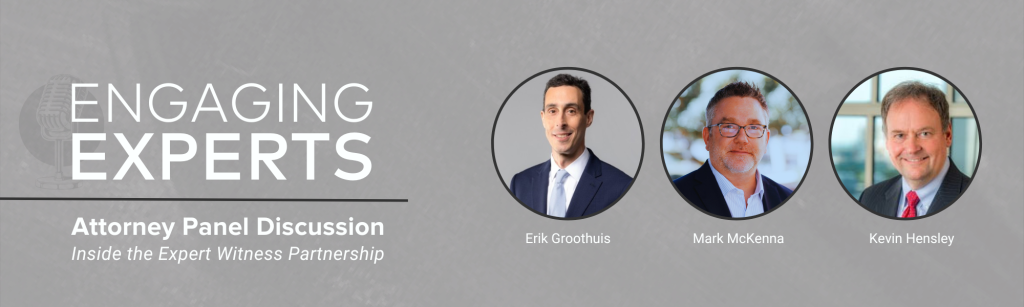
Engaging with Panel Attorneys, Erik Groothuis, Mark McKenna and Kevin Hensley
December 10, 2025In this episode . . .
Ever seen a brilliant expert lose a jury in five minutes? Credentials alone don’t win cases, and today, we’re unpacking why. We’ve brought together three seasoned voices to share what really matters when turning expertise into testimony that persuades:
- Erik Groothuis: Partner at Schlam Stone & Dolan LLP
- Mark McKenna: Professor at UCLA and Partner at Lex Lumina, LLP
- Kevin Hensley: Partner at Barton Gilman
From the first call to cross-examination, our panel dives into the traits that separate great experts from the rest: attention to detail, calm under pressure, and the ability to teach without talking down. You’ll hear why early involvement can save cases from brittle theories and missed evidence, plus the vetting checks these attorneys use to spot credible practitioners versus “for-hire” opinion mills.
We also tackle the messy middle: how much material to share, why oversharing beats ambushes, and the value of starting experts on a consulting basis to preserve candid feedback. The conversation compares venue demands across state, federal, arbitration, and specialized courts, with practical prep tips and mock exam strategies that build confidence. We explore tricky scenarios: when a related specialty is enough, when it falls short, and how cross-examination can expose those gaps.
One message runs through the conversation: great experts combine deep knowledge with clear communication, and great lawyers welcome early challenges to sharpen their case strategy. We wrap up with actionable advice experts can use today: be responsive, avoid surprises, align your schedule with court timelines, and think like a teacher.
If you find this episode valuable, subscribe, share it with a colleague who hires experts, and leave us a quick review telling us the one expert trait you value most.
Note: Transcript has been lightly edited for clarity.
Host: Noah Bolmer, Round Table Group
Guest: Erik Groothuis, Commercial Litigation Attorney and Arbitrator
Guest: Mark McKenna, Professor at UCLA / Partner at Lex Lumina, LLP
Guest: Kevin Hensley, Partner at Barton Gilman
Noah Bolmer: Welcome to Engaging Experts, I’m your host, Noah Bolmer, and today we have a panel discussion with three distinguished attorneys, all returning guests. Erik Groothuis is a commercial litigation attorney and an expert on New York contract law and professional malpractice. Additionally, he’s an arbitrator for the American Arbitration Association. Mr. Groothuis holds a JD from Harvard. Mr. Groothuis, welcome to the panel.
Erik Groothuis: Thank you, Noah. Happy to be here.
Noah Bolmer: Mark McKenna is a professor of law at UCLA and a partner at Lex Lumina LLP, a full-service law firm. He is a sought-after IP expert with numerous publications and holds a JD from the University of Virginia. Professor McKenna, welcome to the panel.
Mark McKenna: Thanks for having me.
Noah Bolmer: Kevin Hensley is a partner at Barton Gilman, where he practices as a trial and appellate attorney on a broad range of matters, including contracts, employment discrimination, indemnity, and more. He’s a published author, a frequent presenter, and has been recognized by Best Lawyers in America. Mr. Hensley holds a JD from Boston University. Mr. Hensley, welcome to the panel.
Kevin Hensley: Thank you, Noah. Glad to be here.
Noah Bolmer: We’re here to discuss one of the most consequential and nuanced collaborations in litigation; the relationship between attorneys and expert witnesses. We’ll explore the strategies and challenges in translating complex expertise into a persuasive legal strategy. I’d like to talk about expert traits in general.
Mr. Groothuis, what do you think makes an expert witness stand out? Are there a couple of key traits or even red flags that separate the great ones from the rest?
Erik Groothuis: For me, the most important trait of an expert is attention to detail, and within that, I would include case deadlines. Sometimes those deadlines are internal because we need to have the client vet things or vet things ourselves before generating the final work product and turning it over to the other side. During the report process, when they’re on the stand, whether in a deposition or at trial, the best ones are truly unflappable. It’s like you have to fake it until you make it. If they look like they’re unperturbed or whatever the gotcha question is, it doesn’t bother them. Many times, the jury or whoever is assessing the facts in the case might not know the difference. For me, that certain level of confidence and unflappability are key issues for a testifier.
Noah Bolmer: Mr. Hensley, your take?
Kevin Hensley: I agree with all that, and a corollary to that is the importance of effective communication. That might be the most important consideration for me because no matter how technically proficient an expert is, if they can’t communicate their knowledge to the jury in a way that they can understand, it’ll be wasted. Being unflappable is part of that communication. Speaking in a way that jurors understand without sounding pedantic. As Erik said, keeping your cool is a great and essential trait if you’re going to have a successful collaboration with an expert.
Noah Bolmer: Professor McKenna, do we teach this enough in law school? Do we teach attorneys how to not only vet expert witnesses for their subject matter expertise, but also the intangibles to look at that make a great expert witness before we engage one?
Mark McKenna: We teach that almost not at all. First of all, it’s an advanced skill of litigation, and law schools already struggle to teach practical application in trial or pretrial settings. [Much] has changed over the past 25 years of my career. There is more experiential learning, but it’s still very difficult to teach out of context. There’s almost by definition a skill you must learn as your career unfolds. Within that, how you deal with an expert, it is an advanced and specific skill set. When I teach, especially in my trademark class, I tell my students [their] capacity to understand expert evidence, especially in that setting. Expert survey evidence can quickly advance your legal career. If you are a young lawyer who is capable and knowledgeable about what the methodologies are, how to talk to experts, and how to think about what makes them strong, you can be asked to do things in a case that most junior associates aren’t able to do. It is something for young lawyers to pay attention to.
Noah Bolmer: Mr. Hensley, the flip side of that coin, are red flags. Do you ever come into a situation where an otherwise perfect expert witness might be at the top of their game, be well published, understand their subject matter, but might not make a great expert witness in front of a jury or a judge at a bench trial?
Kevin Hensley: It happens all the time. Highly accomplished experts, at the top of their field, can be extremely poor expert witnesses. I’ve had to jettison experts, sadly, at a big expense, way into the case when it becomes apparent to me that they are unable to communicate or, more deadly, they’re arrogant. If an expert witness comes across as arrogant and uncooperative, is going to be combative on the stand, the jury’s not going to like [them.] I’ll pull the plug if I can because that won’t work.
Erik Groothuis: What Kevin said totally comports with my experience. That often is the biggest issue. You found the right credentials in the person by the time you’ve brought them on board. What’s harder to determine is if they are at the top of their field, as you say. Do they act like it? You want somebody who’s going to be relatable to jurors, and a surprising amount are not. They don’t like to be told that they should do it a different way or that they’re wrong about something.
Noah Bolmer: Professor McKenna, red flags.
Mark McKenna: I agree with that. I would have said a minute ago, and doubling down on the clarity point, sometimes it’s worse than your expert is lost on the jury. The jury can dislike your expert if they don’t think that what they’re getting from them is explained in a way that feels respectful of their time and their attention. Another for me, especially at the point of choosing an expert, it’s a major red flag for me if when I do the research, it appears to me that the expert will take any case. If they’ll take any case and want to be paid to do the report. I want an expert that is choosy, [who is] particular, and will only take a case if they feel they can give you an opinion that comports with what they really think. The people who are professional experts that I feel [are] just for hire, get exposed over time. That’s not an expert I would want to work with.
Noah Bolmer: Is whether they spend a significant amount of time working for both plaintiffs and defendants’ part of that calculus?
Mark McKenna: It can be for sure. Sometimes it’s easy to make an expert look like the style I just described if they’re always on one side. But even that, if you dig into the reports in the prior cases, you can tell when the party that hired them has a weak case and they’re willing to go to the mat on an expert opinion versus when they’re more careful. When I interview experts, I want to feel like they are asking good questions, and they are pushing back to get more information than I’m providing them. That they are not the kind of expert that is just going to write in the report whatever they think I want them to write.
Kevin Hensley: I’ll add that I like to see an expert that handles both plaintiff and defense work, but it’s not dispositive for me. More important to me is an expert who practices in the field as opposed to spending most of their time as a litigation consultant. If I have a medical expert, I want someone who sees patients and maybe spends 10% of their time and income doing litigation consulting. I want them to spend most of their time treating patients. That would hold true for any field of expertise, engineering, or anything. I don’t want someone who makes most of their money as an expert witness.
Noah Bolmer: Mr. Groothuis, is that important to you when you’re determining whether or not to engage an expert if they are still actively engaged in their field?
Erik Groothuis: If I had to [choose] between somebody who is a practitioner versus an academic exclusive type, I would rather have somebody who’s out in the field doing the things that they’re opining about as opposed to publishing and researching. Circling back to the point made earlier about whether it’s better to have someone who’s an expert on both sides versus one or the other. At my prior firm, one of the partners used this particular expert, who shall remain nameless, but had fabulous credentials. PhDs and master’s degrees from every fancy university, and this guy was notorious [for] saying whatever you wanted him to say. He was part of a consulting firm and was out there peddling the credentials. The problem with that is he looks good on paper, and actually he was an effective testifier, but the pushback process that was referenced earlier- pushing back on things that you tell them, is going to be every bit of that and worse on cross-examination. If they’re writing whatever you want them to say, it’s going to definitely expose them when it comes to cross-examination.
Noah Bolmer: Let’s talk about some of the challenges that come up. I’ve interviewed quite a few expert witnesses, and one of the things that come up from time to time is that experts don’t always they are brought in at the right time. In other words, they wish they had been brought in earlier. Of course, there’s an inherent push and pull between bringing them in too early and also being cognizant of the end client’s financial position. How many expert hours they want? Let’s talk about that timing. Professor McKenna, how do you determine when to bring in an expert witness?
Mark McKenna: This is an important point. The answer for me is I would rather be too early than too late. Sometimes that takes the form of having initial conversations with the expert to get their sense of what they think they might be able to say. What they would add to the case? One of the problems, because I also am an expert is sometimes, when you get brought in late, there are features of the case that are locked in a way where the things that you might be most naturally inclined to say are not available or they’re not helpful at that point. On the lawyer side of the case, having a sense of what the expert’s going to add affects the way you do discovery. It affects the way you think about the strategy of the case. I understand the point about efficiently resolving the case. But to me, I would always rather talk to an expert early. So at least I know what whether and what kind of expert evidence might be coming later.
Kevin Hensley: There are some circumstances where it’s obvious that you need an expert right from the outset. One of my more unusual cases involved a gas boiler explosion at a kielbasa factory. It’s the first exploding Kielbasa case I ever had. It was an ancient facility. The boiler was probably back from the early part of the previous century, and I got a good boiler expert right away. He was with me on the initial visit almost immediately after the explosion. Without him, I would have been lost. We would have lost key evidence. We wouldn’t have gotten the photographs that we needed, and we wouldn’t have had the examination that we needed. That’s fairly obvious when you’re dealing with an emergent situation like that. But generally, I agree with Mark that the earlier the better. I’ll just add that when I do get an expert involved early, I try to keep things oral rather than written initially. You never know how his analysis is going to go. I don’t want to have him committed to something in writing that might conceivably be discoverable. I tend to have phone conversations as much as possible in the early stages of my interactions with an expert. I take my own notes, but I don’t necessarily have him commit anything to writing other than what he needs to remember what he’s seen.
Erik Groothuis: I agree with everything that’s been said until now. In my perfect world, we would have the expert when we’re drafting the complaint. I remember one of my earliest legal malpractice complaints we filed, we researched the law, we wrote up theories of liability, and then we searched for experts later. In some of the claims we were making, it was hard to find somebody who would support them. As you said Noah, there’s always a push and pull. Part of that push and pull is expense, but keeping someone involved, even at a high level as a consulting expert early on will be worth the rewards in almost every case. I do a lot of cases where the experts will opine on damages. That may be the exception here, where the damages issues can wait until the liability issues are sussed out more. On most of the subjects on which experts opine, having them involved earlier is better, and you [have] to explain to the client why it’s important.
Kevin Hensley: I was just going to add that one other big advantage to early involvement is that I myself get educated. I think it’s important that I understand the technical issues in a case. If I don’t understand them, it’s going to be hard to interact with the expert. The earlier I get that education, the better. I feel more comfortable defending the case throughout the course of its life.
Noah Bolmer: Along those lines, if you are not necessarily- you may be familiar with, but you may not be a complete expert, otherwise you wouldn’t need an expert witness necessarily in a particular field. How do you determine which case materials to send to the expert witness without inundating them but also making sure that they have enough that they might be able to spot something via their expertise that you may have missed? What’s the calculus that goes into how much of the case materials that you send to an expert witness when you engage them?
Erik Groothuis: I prefer to overshare in this respect, and part of the reason is typically the other side will get a list of everything that the expert- depends on the way the rules are written. At a minimum it’s what they relied on, and sometimes it’s everything that they considered. I don’t want ever to put an expert in a situation where something comes out at a deposition and they say, “Were you aware of this?” And the expert has to say, “No.” Then you have a fight about, well, does that change your opinion or not? So, I tend to share with them almost everything that I can think of and let them use their judgment as to what they want to rely upon.
Noah Bolmer: Professor McKenna.
Mark McKenna: I second that. I can say this from both sides. The worst thing for me as an expert is getting surprised. I don’t want to learn something that I should have known about the case and that that my lawyer should have told me in the deposition or on cross-examination. I would much rather have more stuff rather than less and just have to write down more things. I do think the inundation point can be right- this is where I agree with Kevin that early verbal conversations are helpful because you can do a lot of frame setting there. You can get a sense of where you think the expert fits in, and then you can talk about what information they feel they need. Sometimes that’s an ongoing conversation where you send batch one and they feel like I wish I knew the answer to this and this is also why having the expert be a good fit in- someone mentioned earlier, attention to detail. Knowing that person’s paying attention to what you send them and they’re going to be asking good questions because you’ve picked somebody who knows what they’re doing.
Noah Bolmer: I’d like to talk about new neutrality for a moment. As you know, an expert witnesses’ duty is to the neutral truth, not to the end client. Obviously, the attorney wants to choose an expert whose opinion gels with their trial strategy. How do you go about squaring those two things? How do you simultaneously allow the expert to have their own opinion without trying to influence them, but also find an expert whose opinion matches what your trial strategy is?
Kevin Hensley: The first thing I would want from any expert is to tell me if I’m wrong. I make that clear from the outset with any expert I engage, particularly medical experts. If there’s a causal relation between an accident and an injury, I from the outset, I’ll say, “Listen, if this caused this injury, I want to know, because then I’ll want to settle the case instead of taking it to trial.” I try to establish that from the outset to have the expert comfortable with giving me the bad news. If they’re not willing to do that, it can be a recipe for disaster. Having that understanding from the outset, and it’s funny, you’d think that would go without saying, but it doesn’t necessarily. It’s important to let the expert know you have to give me the bad news if it’s out there because some of them might assume that you don’t want to hear it, but you do.
Noah Bolmer: Mr. Groothuis.
Erik Groothuis: The way most lawyers deal with the problem that you presented, Noah, is you retain them initially on a consulting basis, and then you’re having presumably freer, more open, and candid conversations. Notwithstanding, Kevin’s point earlier about, having to be careful if there’s no agreement or no rule about what’s discoverable in terms of what you share with experts. That’s why Zoom has been a great tool for dealing with experts. You can share these ideas without sharing screens and without putting things in writing. Those are my thoughts on that.
Noah Bolmer: Professor McKenna.
Mark McKenna: I agree. I want to tie this back to the conversation we had a minute ago, which is you’re in much safer territory, and that’s likely to go much better if you’re dealing with an expert who isn’t somebody who just takes every case and makes their entire living doing expert work. That person is going to feel much freer, also much more constrained because they have the side constraints of the rest of their professional life that they have to deal with whatever it is that they say in your case. If that person doesn’t their living doing expert work, then that is costly. I have a long paper trail and if I were modifying whatever I was saying as an expert for the case, it would be easy for that to get exposed. I agree with Kevin that building a relationship with the expert and making clear that they are helpful to the case, even if it doesn’t mean that they wind up testifying. If they’re clear about what they think is going on it sets the parameters for settlement. It helps you think about how you give advice to your client about what kind of a case they have. They don’t need to be guns blazing, all going to the wall, because that isn’t always the thing that’s most helpful. It’s also that attitude that gets easily exposed, if and when you do use them on the stand.
Kevin Hensley: I wanted to add that collaboration is key. I have had experts who initially gave me an unfavorable opinion, and then we talked it out. On occasion, I’ve noticed something that maybe the expert missed, and I can bring it to their attention. There have been times through collaboration that we can reach a better understanding, and I get an opinion that is helpful. Again, there [are] certainly times when no matter what, the expert isn’t able to help, and it’s good to know that sooner rather than later.
Noah Bolmer: Do you do research? I’m sure you do. What research do you do prior to engaging an expert? Looking through their previous writings, courses, or anything else that they’ve done in public to check if this is somebody who is going to help you out? Is that a large part of the pre-engagement process? Mr. Hensley?
Kevin Hensley: Sure. It has to be. It depends on the field of expertise. For medical experts, there [are] some obvious sources to check. Any profession that is professionally licensed, it’s always good to check the Board of Licensure to see if there’s been any disciplinary action that might be brought out on cross-examination. If deposition transcripts are available, and there are [many] sources for those, it’s good to take a look to make sure the expert hasn’t gone out on a limb that’s going to affect your case adversely. Most of the time, the vetting comes back well. If you’ve got a CV, the credentials are there. You’ve checked for any deposition testimony, trial testimony, and prior engagements so that there are no conflicts. It’s rare that I’ve vetted an expert and decided that I can’t use that expert, but the vetting process certainly is important.
Noah Bolmer: Mr. Groothuis, pre-engagement vetting.
Erik Groothuis: For sure. There are a lot of tools available for that now, not just on Westlaw and Lexus where you can put the expert’s name into a database and figure out. But also, through wider availability of internet searching and AI tools. We for sure do all of that. Sometimes it’s hard to get your hands on reports that they’ve issued in other cases, at least in my world, because they’re typically filed under seal. They’re probably under some kind of protective order. If they’re an academic, they’ve undoubtedly published articles and if you look at the docket, maybe the expert report isn’t available, but in the summary judgment motion in this other case, you can see the gist of what this person was saying. You absolutely need to do that because your opponent will be using that material to cross-examine them and they try to make sure they’re going to [leverage] whatever they’ve said before against whatever they’re saying in your case.
Mark McKenna: I agree with all of that. I’ll just say this, at least to me, an important part of the first phone call, which is where you’re helping- trying to understand what this person’s role might be, what you might be asking them to do, and then asking them tell me what else [they’ve] worked on in the vicinity of this that I should know about, and that can I see those reports and those kind of things. [That] depends a lot on how broad your range of practice is. The cases that I’m doing as a lawyer tend to be within a particular lane. Word of mouth is already a prominent feature of that. That’s an important part of the first conversation, which is just let me know what I should be aware of here.
Noah Bolmer: Let’s move on to venue for a moment. Experts are often engaged in an unfamiliar venue. They may be working in a different state, a different level of government, or it might be their first time in front of a patent judge. What are the preparation methods that you like to use to prepare a new expert witness for a new venue? And as a corollary to that, if there- if the attorney is not offering that preparation, should expert witnesses be expected to proactively research any specific rules that may affect them in a new venue? Mr. Groothuis?
Erik Groothuis: I would not expect the expert to do his or her own research on the particularities of a new venue for them. But if they’ve been working in one particular area, say state courts and now they’re in federal court, or they’ve been in state and federal, and now they’re in arbitration or patent court, you’ll app- you’ll for sure want to educate them on the differences. What might be new and different in the forum, in particular around what are their juries in this forum? Are you testifying live or by video? All those things will affect how the final product comes out. You’ll want to make sure they understand and are comfortable. If they’re not, you can do mock exercises with them, mock examination to get them ready.
Noah Bolmer: Professor McKenna?
Mark McKenna: That’s all right. I agree that I wouldn’t say that I expect an expert to go out and do a bunch of research on that. I would expect an expert to be aware of the possibility that they’re in a forum that’s unfamiliar to them and to be asking good questions about that. Maybe that’s a bit skewed by the fact that because I am a lawyer, I’m attuned to that. It does seem to me that part of what should be on any good expert’s radar screen is who is the audience that I’m going to be speaking to? What are the- what form am I going to be expected to deliver this report? There are huge differences in California between state and federal court in terms of how much information you’re providing. I would think except in a special case where you’re dealing with somebody who is such a specialized expert that they have never had any prior experience, that the experts should be attuned to things like that so they’re aware of what’s coming.
Noah Bolmer: Mr. Hensley?
Kevin Hensley: That’s all right. I’ll just add that whenever possible, I try to get someone who is familiar with the venue. It’s not always possible. In certain specialties, it’s probably less important than others. If I can find an expert who is within a hundred-mile radius of the courthouse, it’s always better. The juries are likely to be a bit more receptive to someone they perceive as local. So, if possible, I’ll try to do that and avoid the whole problem of educating them about that new forum.
Noah Bolmer: Are there ever situations where an attorney does need a rather specialized expert? They may need to not take an expert and put them outside of their lane but move up against the against the edges of their lane, requiring them to do [a] significant amount of research prior to forming an opinion or writing an expert witness report. Is that something that any of you have ever run into?
Kevin Hensley: I recently had a case that required determining a mean high tide line along a beach. That was new to me, and I didn’t know where to start. It ultimately wound up being an oceanographer who could help me. It was a bit outside of his lane, but he felt comfortable doing it. He had enough basic knowledge to go down to the site, look at the clues, and determine where the high tide line was. I felt that as an oceanographer with significant academic experience, he’d certainly qualify as an expert, and he enjoyed it. It was nice for him to get out of the classroom and out into the field. It was a bit of a stretch, but not too much of a stretch where he might be precluded from testifying.
Erik Groothuis: I can’t think of a time where I needed an expert where we couldn’t find somebody who had done that exact thing and had to push them outside their comfort zone. There are some good expert referral services that can help you with stuff like that. Frankly, I’d be afraid to do it on the theory that when they get asked on cross-examination, “Have you ever done this before?” They would have to say, “No.” That’s going to be tough. But, as Kevin indicated, there might be some sui generis situations where no one is an expert in this thing, and you have to do something adjacent to what they are experts on.
Mark McKenna: That’s right. It would make me nervous. One of the things you mentioned, Noah, is the possibility that somebody would have to go do a bunch of research before, and that would make me nervous about using an expert because they’re supposed to be able to bring existing expert knowledge to bear on the particular case. If it requires them to go do a bunch of additional research ahead of time, that would feel to me like you were at some risk there.
Noah Bolmer: Let’s talk about wrapping up a case or wrapping up an engagement from the expert witnesses’ perspective, because often their part of an action ends long before the trial or the totality of the action is over. How should expert witnesses approach attorneys or should they approach attorneys to get feedback on how their performance was? Is this something that they typically do or you typically offer? Professor McKenna?
Mark McKenna: I don’t know how typical it is. My experience has been mixed, but I would say that the experts that I have the most favorable views of and that are ones I would be inclined to go back to always are asking for that information. They’re mostly- they’re not so much about feedback in the sense of did I give you the report you want, but more like how did the case wind up going? What was my contribution to the case? Where did it fit in? Then, if you have feedback for them that has to do with how they presented on the stand and what you what your reactions to those were. I find anybody who is doing enough expert work with regularity starts to develop a sensitivity to that, and that is super helpful feedback. When I’m a lawyer engaging an expert, I try always at the end of the case to give them a sense of where it went and how their piece fit into it.
Noah Bolmer: Mr. Hensley?
Kevin Hensley: I like experts who are interested in the outcome of the case even if they’re no longer involved. That shows they were committed. They were interested. I do get experts following up with me. If the case settled or if there was summary judgment and they’re interested to know. Like Mark, I’m not sure that I have [many] explicit sit-down sessions to debrief, but over the course of the engagement and the collaboration that goes on, myself and the expert have a good understanding of the strengths, weaknesses, and if there were things that needed to be addressed. That came out during the course of the engagement not necessarily with a formal debrief.
Noah Bolmer: Mr. Groothuis?
Erik Groothuis: My experience is similar to what’s been expressed already. I find that experts are often interested in the outcome of the case but rarely if ever are asking for feedback on their work. Lately, I’ve been getting these surveys- if I use an expert whose part of a firm, an accounting firm, or a consulting firm, I’ll get one of these here’s ten questions how did how did we do? I’m not filling those out. If they want to reach out to me, I’m happy to give them my thoughts but I’m not doing a customer satisfaction survey at the end.
Noah Bolmer: Let’s talk about one of the big topics of the day which is AI. Is this something that they should be considering and if so, what are the ethical considerations and also as a corollary do experts need to reveal whether they’ve been using AI for anything is that discoverable? Mr. Groothuis?
Erik Groothuis: I can’t think of an expert engagement so far where this AI issue has come up but I would think that the rules of the road are similar to the rules of the road for attorneys. If you’re going to use that tool and I wouldn’t say categorically that you shouldn’t use it, there are times when it can be an effective tool for processing and digesting a large amount of information, but you want to make sure you understand where that tool is pointed. If it’s ChatGPT it’s pointed at the entire internet, so you have these issues for lawyers about hallucinating cases and things like that. If the expert is using that to facilitate their work, they have to understand what the large language model is pointed at. What have you done to satisfy yourself about the accuracy of the results generated? You’d need to disclose that in a way that you disclose the materials that you relied upon if you’re using an AI model. It seems to me that’s going to have to be disclosed like you would any other model. If you have a damages expert and their damages model is in the form of an Excel spreadsheet most likely the other side’s entitled to that. They would be entitled to know about the use of AI for the same reason.
Noah Bolmer: Professor McKenna I imagine this is something that you have to contend with your students. Tell me a little bit about your thoughts on AI.
Mark McKenna: Yes, it’s thick on the ground in every law school. My first answer is I can’t think of a context in which I would use an expert or I would function as an expert where I would think the use of AI was helpful in that way. Then, I offset that with I think there’s a substantial risk that it winds up giving you something that you are- that you then have a problem with. Expert reports are not that hard to write. It’s not like you need that big of a running start in order to do it. There’s a real risk that it looks like you’re not paying and maybe it is true that you’re not paying enough attention to the case or enough attention to the details. The concern that I primarily have about it when I talk to my students is that they- the concern that the students will treat it as like a substitute for having done the deep dive on their own. It’s inevitable that a lot of these AI tools will be used in the practice of law, but you have to take a skeptical lens at the outputs and make sure that you’re being critical in evaluating what you’re getting from them so you can spot hallucinations. So that you can figure out whether it’s missed the mark. If someone is using that in place of having done the mental work in the first place, they’re not going to be able to do that kind of critical evaluation. In the examples I know about where experts have used AI, and it’s gone badly it looks to me in those cases the expert has used it as a way to do lots of expert reports and they’re not paying close enough attention to the case.
Noah Bolmer: Mr. Hensley, your thoughts?
Kevin Hensley: The expert assistance I need is so case specific. Generative AI to me seems to be geared towards answering big, general questions. I need an expert to look at specific facts of a specific case. I’ve never- to my knowledge anyway none of my experts have used AI in any way to help with their analysis. I can’t imagine that it would be helpful. Someday I may be proved wrong about that but so far that’s my feeling.
Noah Bolmer: Before we wrap up, I’d like to go around the panel and see if any of you have advice for expert witnesses. Let’s start with Mr. Hensley.
Kevin Hensley: It’s what we’ve talked about today, but I would say that responsiveness is critically important. Erik touched on that at the outset, but I need inquiries responded to not in two weeks. Cases move quickly and it can be frustrating if I have to repeatedly follow up to get a report or an answer. I don’t want people to overpromise. I want them to give me realistic expectations for when they can get me the information I need. Because I can plan for it as long as I know what to expect. If you can be responsive, and honest about your other time commitments so that I can plan my part of the case, that’ll be helpful.
Noah Bolmer: Mr. Groothuis.
Erik Groothuis: For me, the main piece of advice I would give is no surprises. That reaches across many different areas not what they’re comfortable testifying about. Also, as Kevin was saying deadlines and their availability. I’ve had cases where we’ve scheduled a jury trial and the expert says, “No, I’m going to be in Egypt for the entire month.” We have to backtrack with the court. When you’re juggling a lot of balls the way litigators do between your opponent, the judge, and the client you want the expert to be the least of your problems. Not surprising the attorneys is a good piece of advice.
Noah Bolmer: Professor McKenna, any last piece of advice?
Mark McKenna: I’ll echo both of those things and here’s where it’s important to remember that especially if you are choosing experts who don’t make all of their money as experts. Nobody else’s lives work on the schedule of litigation. Understanding what happens in a case happens on a different schedule than your normal life and your normal job. That is something you have to be aware of. Something the lawyers need to be aware of too at the beginning and setting expectations. The other piece I’ll add is saying that you get hired as an expert because of your expertise, you succeed as an expert because of the way you’re able to communicate that to people who don’t have that expertise. You need to think of your role as an expert as being a teacher as much as anything else. A teacher where you’re trying to often explain complicated concepts or complicated computations to people who need to take your word for it. You have to help them get to that spot.
Noah Bolmer: Sage advice. Professor McKenna, Mr. Groothuis, and Mr. Hensley, thank you for joining me today on our panel.
Mark McKenna: Thank you for having us.
Noah Bolmer: And as always, thank you to our listeners for joining us for this special edition of Engaging Experts. Cheers.
Subscribe to Engaging Experts Podcast
Share This Episode
Go behind the scenes with influential attorneys as we go deep on various topics related to effectively using expert witnesses.
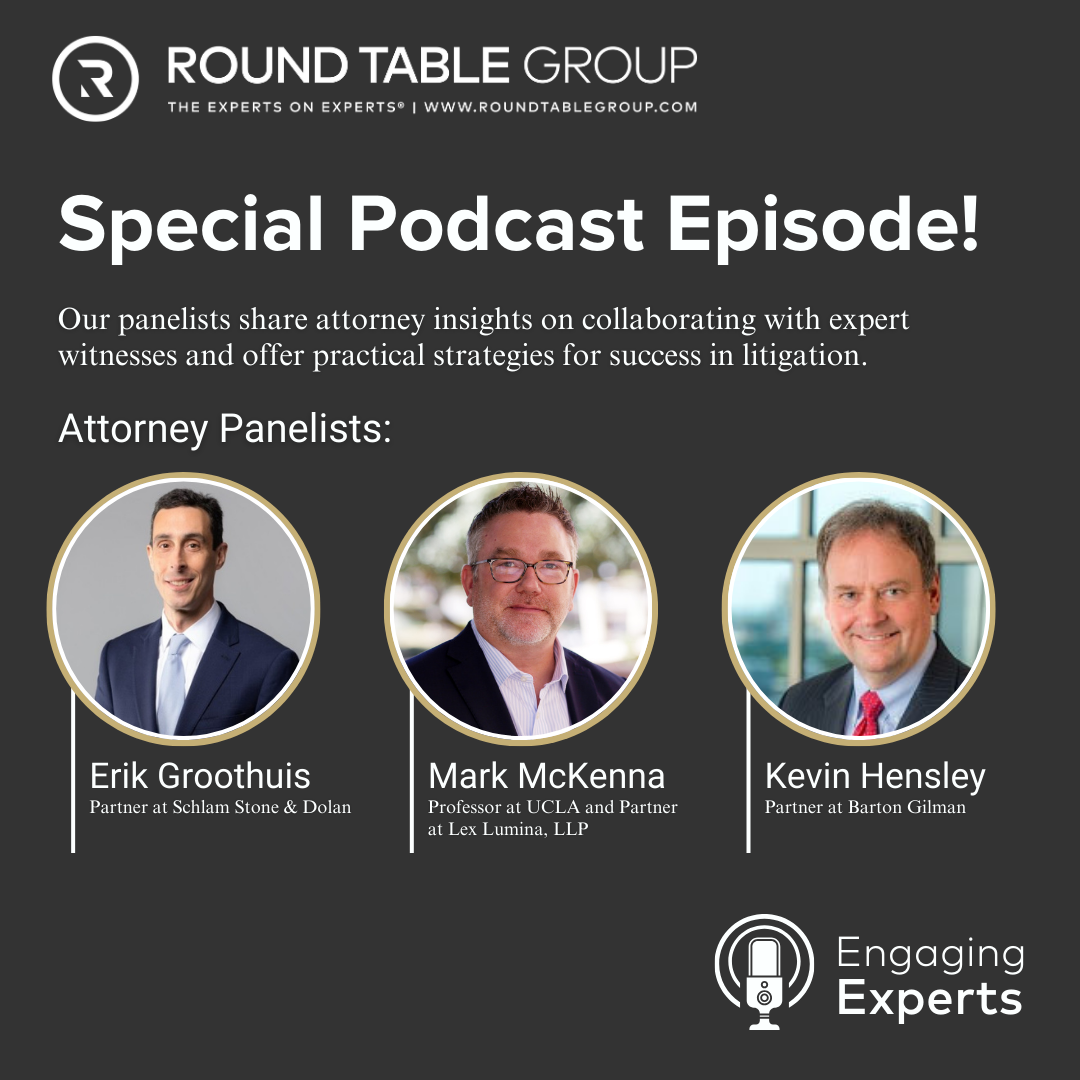
Erik Groothuis, Mark McKenna and Kevin Hensley
Erik Groothuis is a Partner at Schlam Stone & Dolan LLP. He is a commercial litigation attorney and recognized expert on New York contract law and professional malpractice, as well as an arbitrator for the American Arbitration Association. He earned his JD from Harvard Law School. Mark McKenna, Professor of Law at UCLA and Partner at Lex Lumina LLP, is a leading intellectual property authority with numerous publications and a JD from the University of Virginia. Kevin Hensley, Partner at Barton Gilman, is a trial and appellate attorney handling a wide range of matters including contracts, employment discrimination, and indemnity. A published author and frequent presenter, he has been recognized by Best Lawyers in America and holds a JD from Boston University.