

Famous Cases for Expert Witnesses: The Lindbergh Kidnapping
By Noah Bolmer
The 1932 kidnapping of Charles Lindbergh Jr., the infant son of famed American aviator Charles Lindbergh, remains one of the most consequential criminal trials in American history. Beyond its notoriety, the case (New Jersey v. Hauptmann, 1935), is significant for the role expert witnesses played in shaping the evidence presented to the jury. The prosecution relied upon expert testimony to connect physical materials such as wood fragments and handwriting samples, to the accused. The defense challenged the reliability of these methods, raising questions about the standards by which courts admit and evaluate expert evidence.
Background
On the evening of March 1, 1932, Charles Lindbergh and his wife Anne discovered that their twenty‑month‑old son had been taken from his nursery in their New Jersey home. A crudely built wooden ladder was found leaning against the house, and a ransom note demanding payment was left on the windowsill. The crime immediately drew national attention, both because of Lindbergh’s fame and the nature of the abduction.
In the weeks that followed, additional ransom notes were delivered, each repeating demands and threats. Negotiations were attempted through intermediaries, and ransom money was eventually paid, but the child was not returned. Two months later, the body of Charles Lindbergh, Jr., was discovered in a wooded area not far from the family home. The discovery confirmed the worst fears of investigators and intensified the search for whomever was responsible.
The investigation stretched over two years, involving federal, state, and local authorities. Evidence collected included the series of ransom notes, the ladder, and later, marked bills from the ransom payment that began to surface in circulation. In September 1934, police arrested carpenter Bruno Richard Hauptmann after finding ransom bills in his possession and linking him to carpentry materials consistent with the ladder. His arrest set the stage for one of the most closely watched trials of the century, where expert testimony would play a central role in connecting physical evidence to the accused.
Expert Witnessing in 1932
In 1932, expert testimony occupied an uncertain place in American courts. After Frye v. United States (1923), some jurisdictions had begun to develop frameworks for admitting evidence gathered by experts using “generally accepted” methodologies, yet there was no overarching federal rule to standardize the process, meaning practices varied widely from one courtroom to another. Forensic disciplines such as ballistics and chemistry were emerging, but their acceptance depended heavily on the judge’s discretion and the perceived authority of the witness. Similarly, handwriting analysis and medical testimony were frequently used, though their reliability was contested.
Handwriting Expert: Albert S. Osborn
The prosecution engaged several handwriting experts, with the most prominent and impactful being Albert S. Osborn.
- Profession: Forensic document examiner
- Known for: Author of Questioned Documents (1910), foundational text in handwriting analysis
- Role: Retained by the prosecution to compare ransom notes with Hauptmann’s handwriting
Osborn’s reputation preceded him. By the time he was called into the case, he had already shaped the discipline of forensic document examination through decades of practice and scholarship. His book Questioned Documents was widely cited in courts and had established systematic methods for analyzing handwriting, giving judges and juries a framework for evaluating disputed writings. In the trial, his task was to examine the ransom notes alongside Hauptmann’s known writings, including personal letters and financial records, to determine whether the same hand had produced them.
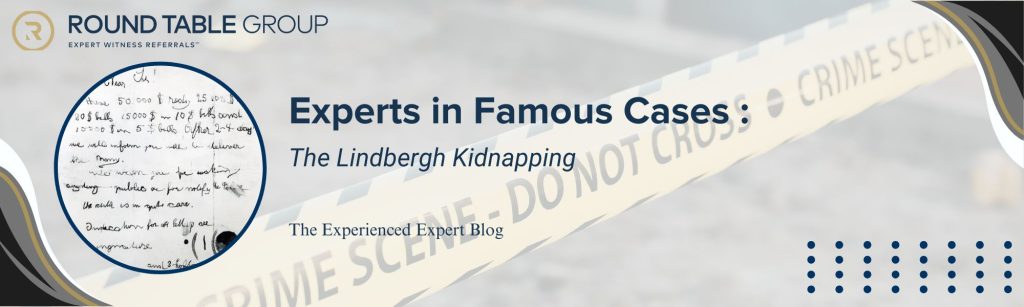
His analysis focused on distinctive features that appeared repeatedly: unusual spellings, letter formations, and stroke patterns that matched Hauptmann’s writing. Osborn prepared enlarged photographic exhibits to make these comparisons visible to the jury, pointing out similarities that he argued could not be explained by chance. He emphasized that handwriting carries individual characteristics much like a fingerprint, and that the ransom notes bore Hauptmann’s unmistakable traits.
On direct examination, Osborn explained to the jury the principles of handwriting identification. He then presented enlarged photographic exhibits comparing the ransom notes with Hauptmann’s known samples, pointing out repeated peculiarities in spelling and letter formation.
Cross‑Examination of Albert Osborn
On cross‑examination, the defense tried to erode the certainty of Osborn’s handwriting conclusions. They pressed him on whether handwriting analysis was inherently subjective, pointing out that different experts often relied on different letters or words in their comparisons. Counsel suggested that similarities between Hauptmann’s writing and the ransom notes could be coincidental, and they asked whether handwriting might change over time due to age, stress, or deliberate disguise.
Osborn acknowledged that handwriting could vary, but he maintained that the consistencies he observed were too numerous and distinctive to be accidental. He emphasized that the repeated misspellings, unusual letter formations, and recurring stylistic habits were markers of individual authorship. The defense’s line of questioning aimed to portray handwriting identification as uncertain science, but Osborn’s insistence on the reliability of his comparisons reinforced the prosecution’s case.
Handwriting Expert: John Trendley
Trendley appeared as a handwriting expert for the defense, to counter Osborn.
- Profession: Handwriting expert
- Known for: Critiquing the reliability of handwriting identification as subjective and prone to error
- Role: Challenged the prosecution’s claim that Hauptmann authored the ransom notes
John M. Trendley lived in East St. Louis, Illinois, and worked as a specialist in examining disputed documents. By the time of the Hauptmann trial in 1935, he had been practicing for nearly forty years, beginning in the 1890s. Trendley was a seasoned courtroom witness, having testified in close to 400 cases over his career, which gave him a reputation as an experienced, if sometimes controversial, handwriting examiner.
Trendley’s expertise extended beyond analysis; he was also known as an imitator of handwriting. During cross‑examination, the prosecution pressed him on this point, suggesting that his ability to reproduce signatures might undermine his credibility. He admitted that he could imitate handwriting, though not always quickly, which the state used to question the reliability of his broader opinions.
In the Hauptmann trial, Trendley reviewed the ransom notes, the photographic copies, and the charts prepared by Albert Osborn and other prosecution experts. In his opinion, Hauptmann did not write the ransom note. He emphasized that different experts relied on different letters and words in their comparisons, underscoring an inherent subjectivity in handwriting analysis. Nevertheless, his arguments would prove less persuasive to the jury, especially when set against the prosecution’s visual exhibits and Osborn’s authoritative presence.
Arthur Koehler: Wood Technologist
On direct examination, Koehler presented himself as a government wood technologist whose specialty was lumber identification.
- Profession: U.S. Forest Products Laboratory wood technologist
- Known for: Leading expert in lumber identification
- Role: Retained by prosecution to connect crime scene to Hauptmann
Arthur Koehler was a wood technologist employed at the U.S. Forest Products Laboratory in Madison, Wisconsin. By the time of the Hauptmann trial, he had established himself as one of the country’s leading specialists in lumber identification, with a reputation for tracing wood to its source through milling marks, grain patterns, and manufacturing characteristics. His expertise was widely recognized in both scientific and legal circles, and he had previously assisted law enforcement in cases where wood evidence played a role.
Koehler’s involvement in the Lindbergh case began when investigators sought to understand the origins of a homemade ladder found at the crime scene. He examined the lumber used in its construction and was able to trace several pieces back to specific mills and suppliers. Most significantly, he determined that one of the ladder rails had been cut from a floorboard in Hauptmann’s attic, creating a direct physical link between the defendant’s home and the crime.
His testimony at trial was presented as a technical demonstration, showing how distinctive milling marks and grain patterns allowed him to match the ladder wood to the attic boards. This evidence provided the prosecution with a tangible connection to Hauptmann, reinforcing the case beyond handwriting analysis and witness account by establishing a physical link between Hauptmann’s home and the crime scene.
The Cross Examination of Arthur Koehler
With no corresponding expert for the defense, on cross‑examination, Arthur Koehler faced a strategy aimed at softening the impact of his testimony. The defense acknowledged his credentials but pressed him on whether wood identification could ever be truly conclusive. They suggested that milling marks and grain patterns might appear in lumber from different sources, raising the possibility of coincidence. Koehler conceded that obviously, he could not trace every piece of the ladder to Hauptmann’s home, and the defense emphasized that only one rail matched the attic floorboard while the rest of the ladder wood came from outside suppliers. Of course, that any portion of the ladder was directly connected to Hauptmann made the distinction essentially moot.
The defense also questioned whether his methods were fallible, portraying his conclusions as persuasive but not definitive. Their goal was to reframe his testimony as circumstantial evidence rather than absolute proof. Despite these challenges, Koehler remained firm, insisting that the match he identified was distinctive and provided a strong physical link between Hauptmann’s residence and the crime scene.
Clash of the Experts
The Lindbergh trial became a showcase for expert witnesses, and their testimony shaped the jury’s perception of the case as much as the dramatic narrative of the crime itself. Albert Osborn’s handwriting analysis tied Hauptmann to the ransom notes, while Arthur Koehler’s wood identification linked the homemade ladder directly to Hauptmann’s attic.
The defense, in contrast, relied on experts reactively. John Trendley’s handwriting testimony was meant to counter Osborn, but his critique of subjectivity lacked the same authoritative presence and visual exhibits. Without a wood technologist of their own, the defense could only question Koehler’s certainty rather than present an alternative explanation. Their experts were positioned to poke holes in the prosecution’s case, but did not build an independent narrative.
For the jury, the contrast was stark—though not decisive in itself. The prosecution’s experts appeared confident, methodical, and supported by tangible demonstrations, while the defense’s experts seemed less persuasive and more defensive. The trial thus highlighted both the growing reliance on forensic specialists in American courts and the uneven weight their testimony could carry depending on credibility, presentation, attorney strategy, and the strength of supporting exhibits.
Verdict and Legacy
Expert testimony played a decisive role in Hauptmann’s conviction, and long after the trial, each living juror stood by their decision. Trendley’s critique of handwriting analysis underscored the subjectivity of the field, but it did not carry the same authority or visual impact as Osborn’s exhibits. The case elevated forensic specialists in American courts, while at the same time, the disagreements among handwriting experts exposed the limits of the discipline, sparking debate that still continues long after the trial.
If you’d like to be considered for expert witness opportunities, join Round Table Group. For over 30 years, we’ve connected litigators with the most qualified experts across disciplines. Call us at 202‑908‑4500 or sign up today to learn more.